
Kabaddi: From the Mud Arena to the Global Screen
कबड्डी एक संपर्क-आधारित टीम खेल है जिसकी उत्पत्ति भारतीय उपमहाद्वीप में हुई। हर टीम में सात खिलाड़ी मैदान पर होते हैं। मुख्य क्रिया 'रेड' है, जिसमें एक खिलाड़ी विपक्षी आधे हिस्से में जाकर लगातार 'कबड्डी' का उच्चारण करते हुए किसी प्रतिद्वंद्वी को छूकर अपने हिस्से में लौटता है; सफल रेड पर अंक मिलता है, पकड़े जाने पर रेडर बाहर हो जाता है। रेड की अधिकतम अवधि 30 सेकंड है। कबड्डी 1982 के दिल्ली एशियाई खेलों से पदक का खेल है, और महिला कबड्डी 2010 के ग्वांगझोउ एशियाई खेलों से शामिल हुई। भारत लंबे समय तक पुरुष वर्ग का प्रभावी देश रहा; 2018 जकार्ता एशियाई खेलों में ईरान ने स्वर्ण जीता, जबकि 2022 हांगझोउ में भारत ने खिताब वापस जीता। 2014 में शुरू हुई प्रो कबड्डी लीग ने खेल को फ्रैंचाइज़ी-आधारित पेशेवर ढाँचा और बड़ा टेलीविज़न दर्शक वर्ग दिया।
Every evening, across thousands of Indian villages, the same scene repeats itself. A rectangular patch of packed earth beside a field, spectators standing on all four sides, and in the middle two groups of seven who link hands into a chain. A player comes forward, holds his breath, chants 'kabaddi-kabaddi' without pausing, touches someone, and turns to run. If he returns safely, the point is his; if he is caught, he goes down into the dust. The scene is centuries old. But over the past decade this same game has travelled a distance that few Indian sports can match — from the mud arena to air-conditioned indoor stadiums, and from there to prime-time television.
Kabaddi today is not merely a sport. It is a media product, a franchise economy, and a channel through which hundreds of rural families have, for the first time, acquired national recognition. But the journey has brought questions with it. Has commercialisation altered the game's soul? Is the expansion confined to a handful of states and a handful of cities? And can India's game retain the dominance it held for decades?
What the game is: the architecture of rules
A kabaddi court is roughly 13 metres wide and 10 metres long, divided by a midline. Seven players take the field per side, with five substitutes. A match runs in two halves of twenty minutes each.
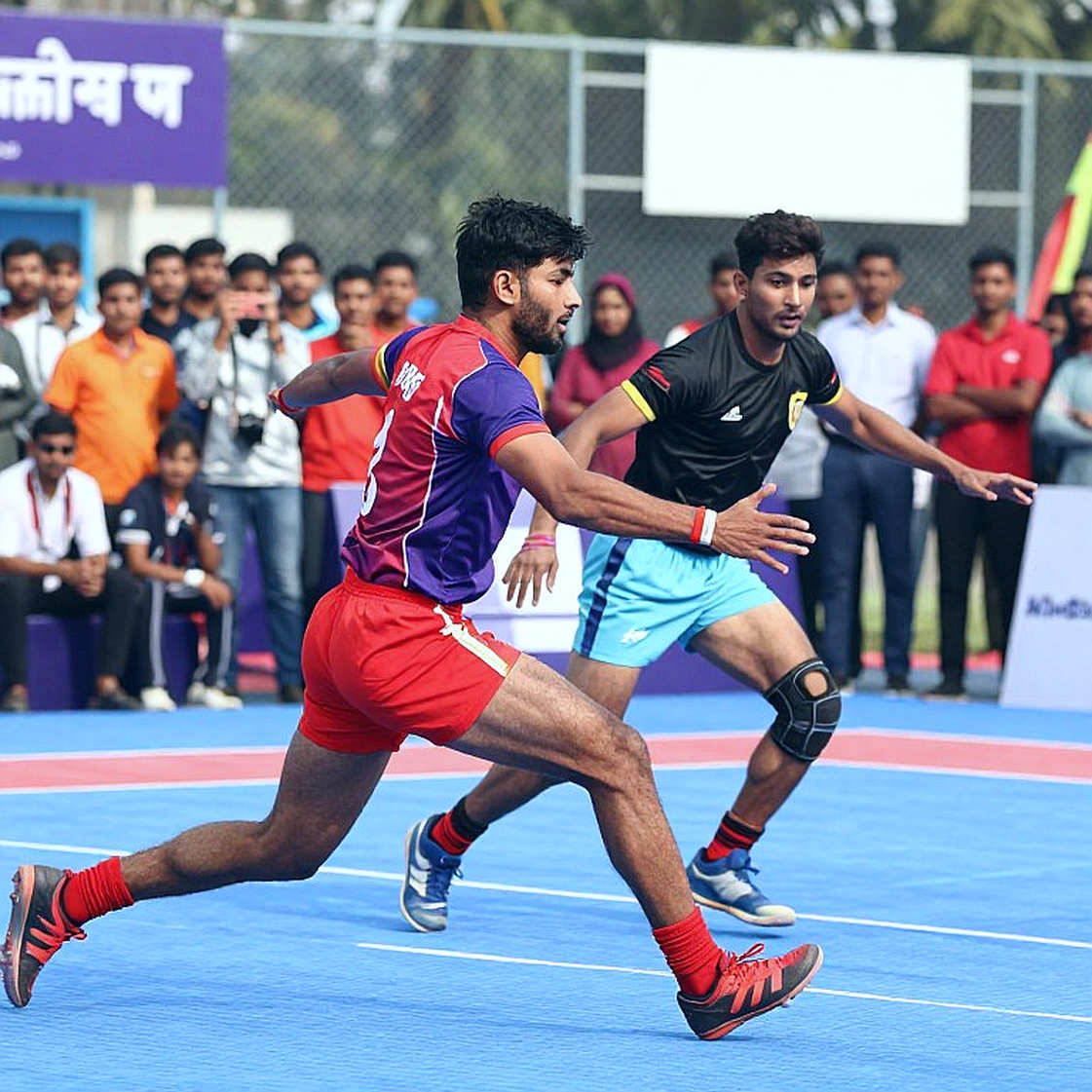
The core is the raid. A raider crosses into the opponent's half and must continuously chant 'kabaddi' without drawing breath — the chant is the game's heartbeat; when the breath stops, the raid ends. A raid lasts a maximum of thirty seconds. The raider must touch an opposing player and return to his own half. A successful touch earns a point and sends the touched defender out. If the raider is caught and prevented from reaching his own half, he is out and the opposing side scores.
The bonus line adds another layer: a raider who crosses it and touches a defender earns an extra point, provided he returns safely. Defenders can also achieve a 'lona' — if the entire opposing side is out, all seven players return to the mat, and the game's biggest momentum shift occurs. Defence has its own science: seven defenders form chains, sometimes by holding hands, sometimes shoulder to shoulder. Breaking that chain is the raider's art; holding it is the defender's craft. A good defender reads the raider's momentum and commits before the foot lifts. This is why kabaddi is often described as boxing without punches — reaction time, balance and bodily control decide outcomes.
Roots and a quiet history
The name is linked to the Tamil 'kai-pidi', meaning to hold hands. The game has carried different names across regions — 'ha-du-du' in Bengal and Odisha, 'hututu' in Maharashtra, 'kaudi' in Punjab, 'chedugudu' in the south — evidence that it belonged to the entire subcontinent rather than to any single language or province.
Folk memory ties the game to the Mahabharata, with Abhimanyu's breaking of the chakravyuh retold in village narratives as kabaddi. Historically this claim is unverified, but its cultural weight is not diminished by that. A game that has been part of the village evening for centuries invites mythological explanation.
Modern kabaddi took shape in the early twentieth century. Standardised rules were prepared in India around 2026 to bring regional variants into a common framework. In 2026 kabaddi was presented as a demonstration sport at the Berlin Olympics — the first appearance on an international stage. After independence came organisation: the Amateur Kabaddi Federation of India was founded in 2026, and the first national championship followed in 2026. The decisive turn came in 2026, when kabaddi was included as a medal sport at the Asian Games in Delhi. That single decision placed the game inside an international structure and reshaped its coaching, selection and funding.
Asian Games: decades of dominance, and its breaking
From 2026 onward, India's men's dominance in Asian Games kabaddi became near-permanent, with gold medals in successive editions. The dominance was treated as so natural that for years the question of whether it could be challenged was barely asked.
The country that broke that assumption was not India's neighbour but Iran. Iran developed kabaddi over years as a disciplined sport, building a training system centred on physical preparation, video analysis and defensive strategy. At the 2026 Jakarta Asian Games, Iran won men's kabaddi gold, leaving India with silver. It was a watershed: the game was no longer one nation's monopoly. At the 2026 Hangzhou Asian Games India reclaimed gold, but the win was earned through struggle rather than assumed.
Beyond the Asian Games, world championships and other international events have seen Indian success, but their organisation has been irregular. The structural weakness of international kabaddi is precisely that it lacks the continuous, global, commercial calendar that cricket or football possesses. The international map remains limited to a few countries — India, Iran, Bangladesh, Pakistan, Nepal, Sri Lanka, South Korea, Japan, Kenya, Poland and a handful of European nations — and in most of these the base is thin.
Pro Kabaddi League: the game's rebirth
If one date must be chosen that changed kabaddi, it is 2026, when the Pro Kabaddi League launched in India — a franchise-based, television-centred league that gave the sport a professional structure. It was built in partnership between a private sports management company and a major broadcaster, and its format was designed around Indian television habits: events in smaller cities, a travelling caravan, fast matches.
The first season featured eight teams, anchored to cities and regions. Within a few years the number reached twelve. Player auctions became the norm, with domestic and foreign players bought by franchises — a system borrowed from cricket's Indian Premier League that permanently altered the sport's economics.
The direct impact fell on players from rural India who had previously depended on government jobs or departmental teams. Athletes who had grown up on roadside grounds, without academy backgrounds, suddenly had money and, more importantly, television recognition. This is why kabaddi is often described as a democratic revolution in Indian sport: success no longer required an English-medium school or metropolitan facilities.
The league changed presentation as well. High-definition cameras, slow-motion replays, sound design, drumming crowds and a new commentary style turned the game into an event. The surface changed too: from mud to mat, altering both the nature of injuries and the speed of play. Many older players argue the mat made the game cleaner, but the grip of earth and the softness of a fall are gone.
Stars who came from outside the system
Anup Kumar, known as 'Captain Cool', balanced raiding and leadership so effectively that he became one of the game's most recognisable faces. Rohit Kumar's raiding carried an aggression that pulled spectators in. Ajay Thakur's experience and tactical reading turned tight matches. Manjeet Chhillar is counted among defenders whose identity is collision itself.
But the most discussed name is Pardeep Narwal. His 'dubki' — ducking low and cutting beneath the defenders' chain — became one of the sport's signature inventions. He rewrote raiding etiquette: instead of playing safe on low points, he took repeated risks and piled up scores. Such players become style icons rather than merely athletes, and that is the fuel of kabaddi's new economy.
Among foreign players, Iran's Fazel Atrachali stood out, counted among the league's most valuable imports on the strength of his defensive positioning and match awareness. There is an irony here: the country that broke India's international dominance began supplying the Indian league with its most prized defenders, raising the level and giving Indian raiders a new challenge.
Women's kabaddi: a stage, but not a market
One major gap remains. Women's kabaddi entered the Asian Games at Guangzhou 2026, and the Indian women's team won gold at that first edition. Indian women have since performed well internationally. Domestically, however, women's kabaddi never received the commercial platform that the men's game got through the Pro Kabaddi League.
The consequence is continued dependence on departmental teams, railways, police and state government jobs. Where a male player can be auctioned for crores, a female player must anchor her career in government service. This gap raises a direct question about the game's image: is kabaddi's rise genuinely for everyone, or for half the sport?
Women's national championships and junior competitions continue, and the base is strong in some states — notably Haryana, Uttar Pradesh, Madhya Pradesh and Maharashtra — but broadcast, sponsorship and audience remain far smaller than for the men's game. Closing that gap will require market decisions, not just government schemes.
The reality at ground level
Behind the league's glossy narrative lies a less-discussed truth: talent identification in Indian kabaddi still depends heavily on chance. A ground in the village, access to a coach, adequate nutrition and recovery from injury are distributed unequally. Players who reach the league often arrive through a local patron or sponsor.
Injuries are a serious issue. Collisions, falls, twisted knees and shoulder impacts are routine, and mat surfaces have added friction injuries. A professional career is short on average, and post-retirement financial security has no strong framework. Some states offer job quotas for athletes, but not universally.
There is also geographical concentration. The league gave more platform to players from certain states, while talent in the northeast, Odisha, Jharkhand and parts of the south remains marginalised. Most franchises are anchored in large urban markets where advertisers are interested.
The arithmetic of television
Kabaddi's rebirth is fundamentally a broadcast success. When the league began, the central question was whether Indian audiences would watch anything other than cricket in prime time. The answer was yes. Kabaddi suits television unusually well: a new event every thirty seconds, a win-or-loss possibility in every raid, and rules simple enough for a first-time viewer to grasp in ten minutes. In cricket an over can produce nothing; in kabaddi every raid is a small drama.
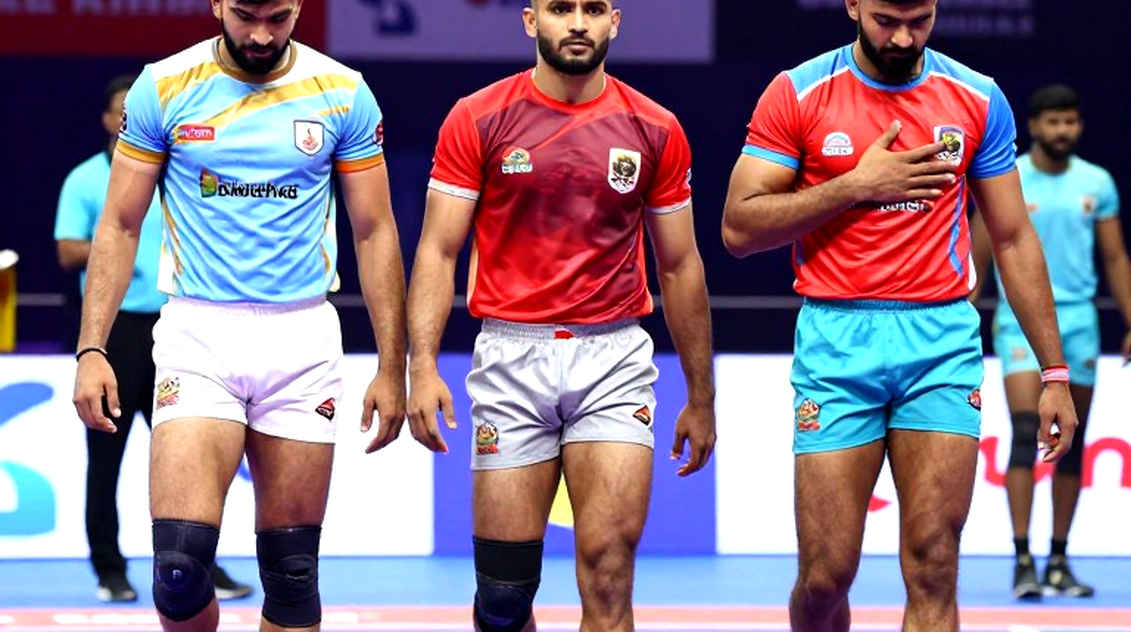
But the success has limits. The audience base is largely domestic, and the league has not built a large viewership outside India. The reason is not merely language or marketing: in most of the world kabaddi has no local ecosystem. Where there is no local game, there is no audience.
Dependence on a single broadcaster and a single promoter also raises long-term stability questions. The history of sports leagues shows that when initial enthusiasm fades, franchise values and player prices fall. Kabaddi will need to diversify revenue — beyond tickets and broadcast rights into sports tourism, merchandising and digital rights.
Technology and the changing face of training
Kabaddi is quietly becoming a data game. Teams use video analysis to read which raider favours which direction, which defender is weaker on which foot, and which defensive pattern repeats under pressure. Training has shifted from pure strength and endurance toward speed, flexibility, reaction time and nutrition, with physiotherapists and sports science advisers attached to franchises. But this professional infrastructure remains confined to the league; state and district level coaching lags far behind.
Dominance versus global expansion
Kabaddi faces a fundamental contradiction. India wants the game to become global, but India's competitive superiority is itself the biggest obstacle to global expansion. When one country wins consistently, funding the sport elsewhere becomes harder. Iran's rise is a healthy signal precisely because it proved India can be beaten. Bangladesh has a deep kabaddi tradition and has been competitive in international matches. South Korea has registered its presence at the Asian Games, and efforts have been made in African countries such as Kenya.
The biggest future question is whether kabaddi can enter the Olympics. That requires a proven organised structure across a defined number of continents and countries: regular national championships, adherence to standardised rules, and a permanent international calendar. Olympic inclusion does not appear imminent, but the direction is clear — the sport must move toward a professional, regular, international framework.
Questions that should be asked
One claim is repeated often: kabaddi is the poor man's game, so its rise matters socially. That is true, but only partly. Being a poor man's game and offering poor players sustainable careers are different things. The league has created a bright upper layer in which a few hundred players earn well. Beneath it are thousands who play without security, insurance or an alternative.
The second question concerns the balance between commercialisation and the game's soul. Mud, bare feet and informal rules were part of kabaddi's folk identity. Now there are mats, shoes, sponsored kits and television graphics. That is not bad; every sport must modernise to survive. But it is worth asking how much accessibility survives modernisation. If expensive academies and urban facilities become prerequisites, kabaddi will have lost its greatest advantage.
The third question is governance. Like many Indian sports federations, kabaddi's has periodically been dogged by disputes, election controversies and administrative instability, and reports of factionalism have surfaced internationally as well. A sport with global ambitions cannot do without clean, transparent administration.
The road ahead
Taken as a whole, what kabaddi has achieved in a decade is remarkable. A game once dismissed as a village pastime is now a multi-crore television product. It has given thousands of young people a route that did not previously exist, and it has established in Indian sporting culture the idea that cricket is not a prerequisite for popularity.
The next phase is harder. The first decade's task was to prove the game could run. The next decade's task is to make it sustainable — an equal stage for the women's game, reach into smaller states and the northeast, injury insurance and retirement security for players, and a group of internationally competitive nations capable of challenging India consistently.
The journey that began on packed earth now stands at a significant turn. Kabaddi possesses something very few Indian sports have — audience, money and recognition. The question is whether that will be used to turn the game into an institution, or leave it as an entertainment product. That answer has not yet been written.