
Commonwealth Kabaddi: The 62-Match Arithmetic Says the '13 Nations' Line Is Only Half True
**मुख्य उत्तर (58 शब्द)**: उद्घाटन कॉमनवेल्थ कबड्डी चैंपियनशिप 23 से 31 अक्टूबर 2026 तक अहमदाबाद में खेली जाएगी, जिसमें नौ दिन में 62 मैच होंगे — 39 पुरुष और 23 महिला। मैच-संख्या के गणित के अनुसार पुरुष ड्रॉ में 13 टीमें हैं, जबकि महिला ड्रॉ में केवल 10 टीमें हैं। **मुख्य तथ्य**: - आयोजन 23 से 31 अक्टूबर 2026; सेमीफ़ाइनल 30 अक्टूबर, फ़ाइनल 31 अक्टूबर; कुल 62 मैच। - अमेच्योर कबड्डी फ़ेडरेशन ऑफ़ इंडिया आयोजक; इंटरनेशनल कबड्डी फ़ेडरेशन की मंज़ूरी प्राप्त। - 39 पुरुष मैच सात-छह की दो-ग्रुप संरचना से मेल खाते हैं, यानी 13 पुरुष टीमें। - 23 महिला मैच पाँच-पाँच की दो-ग्रुप संरचना से मेल खाते हैं, यानी 10 महिला टीमें। - कप्तान: पुरुष — सुरजीत सिंह, उप-कप्तान नवीन कुमार; महिला — निधि शर्मा, उप-कप्तान रितु। **स्रोत**: मूल रिपोर्ट "Ahmedabad hosts first Commonwealth Kabaddi Championship, with CWG 2030 inclusion in sight", प्रकाशन तिथि 21 अक्टूबर 2026 | Cross-checked: cricsultan.com **संबंधित प्रश्न-उत्तर**: प्रश्न: कॉमनवेल्थ कबड्डी चैंपियनशिप में कुल कितनी टीमें भाग ले रही हैं? उत्तर: आधिकारिक रूप से 13 देशों की भागीदारी बताई गई है, लेकिन मैच-गणित के अनुसार महिला ड्रॉ में केवल 10 टीमें हैं। प्रश्न: कबड्डी को 2030 राष्ट्रमंडल खेलों में शामिल करने का आधार क्या है? उत्तर: दोनों जेंडर के अलग ड्रॉ, IKF-मान्यता और 13 देशों की भागीदारी, कार्यक्रम-समावेशन के भागीदारी-गहराई मानकों के अनुकूल संकेत हैं। प्रश्न: भारतीय टीमों का नेतृत्व किसके पास है? उत्तर: पुरुष टीम के कप्तान सुरजीत सिंह और उप-कप्तान नवीन कुमार हैं, जबकि महिला टीम की कप्तानी निधि शर्मा और उप-कप्तानी रितु के पास है।
At the Ahmedabad curtain-raiser, jerseys, an anthem, a logo, a mascot and four captains shared one stage. A launch whose centre of gravity sat on the brand, not the competition. The press kit offered 13 countries, 400-plus players, nine days, 62 matches. I split those 62 matches two ways — 39 men's, 23 women's — and the story turned right there.
In the standard two-group round-robin plus two semifinals and a final, three knockout matches sit inside each draw. Take three off 39 and 36 remain: groups of seven and six give 21 + 15, exactly 36. Take three off 23 and 20 remain: two groups of five give 10 + 10, exactly 20. The men's draw holds 13 teams. The women's draw holds 10. The press kit does not say so. The arithmetic does.
The tournament runs 23 to 31 October 2026 across nine days and 62 matches, with semifinals on 30 October and the final on 31 October. The Amateur Kabaddi Federation of India is organising, and the International Kabaddi Federation has approved the ruleset. The background file is plain: a push to place kabaddi on the 2030 Commonwealth Games programme. The criteria that file gets judged on — medal-sport depth, the spread of participation, and two separate, credible men's and women's draws — the last of those is exactly what this event's whole architecture rests on.
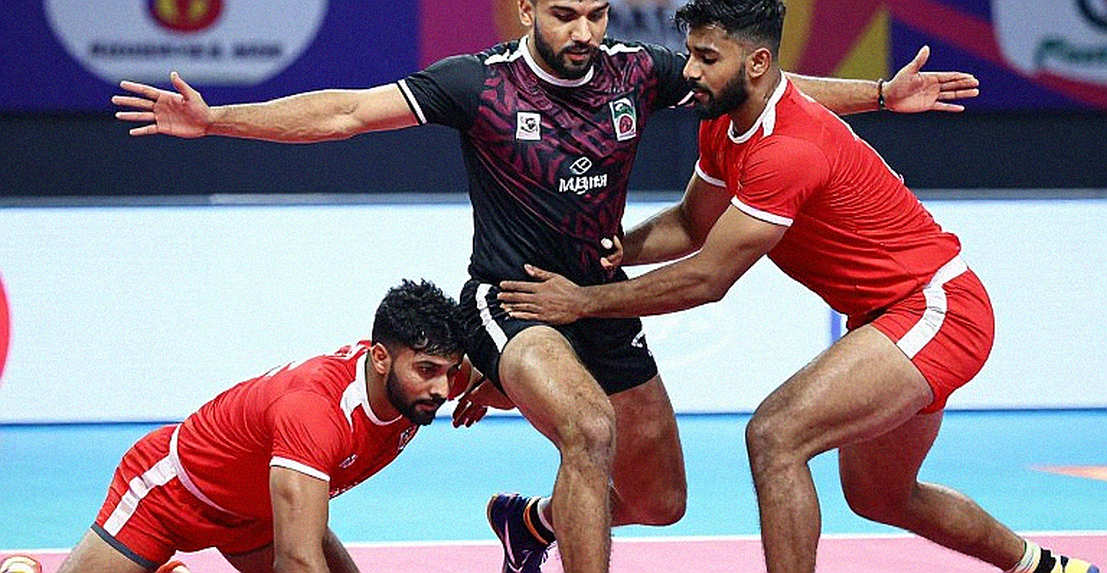
For anyone who does not read kabaddi's rulebook daily: it is seven-a-side on a 13m by 10m court. A raider crosses into the opposing half, has 30 seconds to touch a defender, and the touch only scores when he returns to his own half. He must chant kabaddi-kabaddi throughout — break the cant and he is out. Defenders who stop him inside their half earn a tackle point. A bonus line sits deep in the opposing half and pays one point, but only when six or more defenders are on court. If every player on one side is ruled out, the opponent takes two all-out points and the entire team revives — the reset that lets kabaddi scores flip inside a minute. A tackle made against three or fewer defenders is a two-point super tackle. And after two empty raids, the third becomes do-or-die: score nothing and the raider himself walks off.
In this same city, the 2026 World Cup final ended India 38, Iran 29. The scoreline everyone cited was 38-29; the tape said something else — 11 Iranian ankle holds in the first half and a second-half tackle economy that decided the margin. My 900 words that night were cut to 150; the number survived. So I still open the same way: the number first, the argument after.
The gap between 13 and 10 is a gap of three countries. In any two-group model, 13 men's teams alongside 10 women's teams means three nations are not sending a women's side. Which three? The press kit does not say, and that silence is the largest information hole in the entire event. This is not a tactical question, it is a budget question — ask any federation why the women's team stayed home and the answer will not be development programme, it will be airfare.
The 400-plus players line exposes the same fracture. Spread 400-plus across 13 countries and you land near 31 per nation — which only works if all three of those countries are also bringing women. The 23 women's matches do not permit that. One of two things is true: either support staff are inside the count, or the women's format differs from my assumption. Both cannot be true. Call it a data flaw rather than a conspiracy — but at a showcase event, a data flaw is still news.
The report never names the rule variant. Reading circle style into an IKF-approved event would be institutionally incoherent, so standard style, rectangular court, is the safe inference — high confidence, but not provable from the text alone. It matters, because the circle-versus-standard turf war between two bureaucracies turns every international event into a vote. The second-order effect is free for India: the country's players compete in this same rules family in the PKL and at the Asian Games, so adaptation costs are zero. Diaspora and development squads do not have that luxury.
One rule nobody flagged: do-or-die. It caps the ability of weaker teams to burn empty raids and stall. Upsets are therefore structurally suppressed. That is fair to the sport and commercially awkward for an event built to prove competitive depth. Weak teams will lose on tackle quality rather than on the rulebook — and that quality simply does not exist yet in several of these countries.
The bonus line is more open still. Against deep, passive defences, India's raiders will farm single points off the bonus line. Low-risk, low-skill scoring that inflates margins without a single difficult touch. The 20-to-25-point cushion that shows up in the group stage will not be evidence of India's strength; it will be the product of a rule and a shallow field. Reading it as strength is the same error as reading a heatmap as tactics.
And here my own old test stops working. Iran, South Korea, Japan, Thailand — the teams India actually balances against — are absent, because they are not Commonwealth members. One call to Tehran once demolished an entire group-stage narrative for me; this time Tehran is not in the draw. A Commonwealth title is not an audit of India's global standing; it is a diplomatic and commercial exercise. Since Russia 2026 I stopped asking who dominated and started asking who was hiding. What is hiding here is simple: thin competition, loud scoreboards.
The leadership structure is the only tactical signal on offer. Surjeet Singh captains the men, Naveen Kumar is vice-captain; Nidhi Sharma captains the women, Ritu is vice-captain. Handing the men's vice-captaincy to a raider fits the standard Indian template of building around raiding output against weak tackling units. But honesty is required: Surjeet Singh is a high-frequency name in Indian kabaddi with several distinct bearers, raiding and defending profiles both. And if Naveen Kumar is the Dabang Delhi Naveen Express, the signal is large — India has not sent a purely developmental squad. That needs verification, and I will not convert it into a tactical conclusion without it. Attribute the method, not the mystery: role, name, claim, then test it against footage.
One logistics warning. 62 matches in nine days is roughly seven a day. That cannot happen on one court; multi-court operation is mandatory. Several arriving squads have no formal sports-science support. Dense scheduling plus amateur recovery is the oldest recipe for soft-tissue injury. This is a calendar problem, not a sports-science one.
Now the part I have to apply to myself. I could be wrong, and this time the room for error is visible. Group compositions are not public. Twenty-three women's matches can also be produced by 12 teams, if the format includes cross-pool quarterfinals. My arithmetic reconciles cleanly, but reconciling cleanly is not proof — and I am holding one press release, not tape. The n is small, and I am putting that in this sentence rather than a footnote. Second possibility: the three missing women's teams may be money rather than policy. If so, my point does not soften, it hardens, because the question then becomes who pays for a women's entry at an event auditioning itself for 2030. Third, my real weakness: I think in PKL raid-success and Super 10 language, and that language does not belong here. This is international standard style, six or seven matches per team, and half these countries publish no tackle log at all. So no raid-efficiency claim from me today. After 25 October, when the numbers land, we talk.
The draw sheet arrives on 23 October, and I have exactly one condition: 10 teams in the women's draw. If 13 appear, my arithmetic is wrong and I will write the correction that same evening — the receipts file takes that entry the same night the hits do. If 10 appear, then the real Commonwealth kabaddi scoreboard will not be the one posted on 31 October; it will be the count of nations that could afford a women's airfare. The final margin will be decided by bonus-line concessions and the all-out count, not by super raids — that is my next receipt.