
Kabaddi's Changing Face: From the Clay Arena to an Era of Data and Strategy
कबड्डी क्या है और यह कैसे खेली जाती है? कबड्डी एक संपर्क खेल है जिसमें सात खिलाड़ियों की दो टीमें होती हैं। एक रेडर साँस रोककर विपक्षी हिस्से में जाता है, एक या अधिक डिफ़ेंडर को छूकर लौटता है; लौटते समय साँस टूटने पर वह आउट हो जाता है। डिफ़ेंडर उसे पकड़कर, रोककर ज़मीन पर गिराते हैं। पिछले एक दशक में यह खेल ताकत-आधारित से रणनीति-आधारित बन गया है — वीडियो विश्लेषण, प्रदर्शन डेटा, स्पोर्ट्स साइंस और विशेषज्ञ डिफ़ेंस प्रणालियों के कारण। बोनस लाइन, डू-ऑर-डाई रेड, सुपर टैकल और ऑल-आउट जैसे नियमों ने खेल की गति बढ़ाई है और निष्क्रियता को महँगा बना दिया है। भारत में यह ग्रामीण इलाकों से प्रतिभा निकालने वाला सबसे सुलभ खेल है, क्योंकि इसमें महँगे संसाधनों की ज़रूरत नहीं होती। महिला कबड्डी तेज़ी से आगे बढ़ रही है, हालाँकि वित्तीय पैकेज और प्रसारण कवरेज में असमानता बनी हुई है। व्यावसायिक लीग ने खेल को नई अर्थव्यवस्था दी है, लेकिन आय का बड़ा हिस्सा कुछ शहरों और सीमित प्रायोजकों पर निर्भर है। अंतरराष्ट्रीय स्तर पर खेल दक्षिण एशिया से बाहर भी फैल रहा है, पर वैश्विक ढाँचा अभी निर्माणाधीन है।
Morning at the Akhara
It is five in the morning. On the edge of the village there is a clay court, softened by last night's rain. Twenty-odd young men stand in two lines. There is no coach, no scoreboard, no camera. There is only a sound — kabaddi, kabaddi, kabaddi — that leaves with the breath and stops with the breath. That is the oldest rule of this sport: keep breathing, or the game is over.
This scene repeats every morning in hundreds of districts across India. But what has happened outside that akhara over the past decade has changed the identity of the game. Kabaddi is no longer only a sport of strength and courage. It has become a sport of video analysis, sports science, taping, high-speed cameras and a transfer market. The clay court is still there, but the athlete who emerges from it now enters a very different world.
The structure of the game
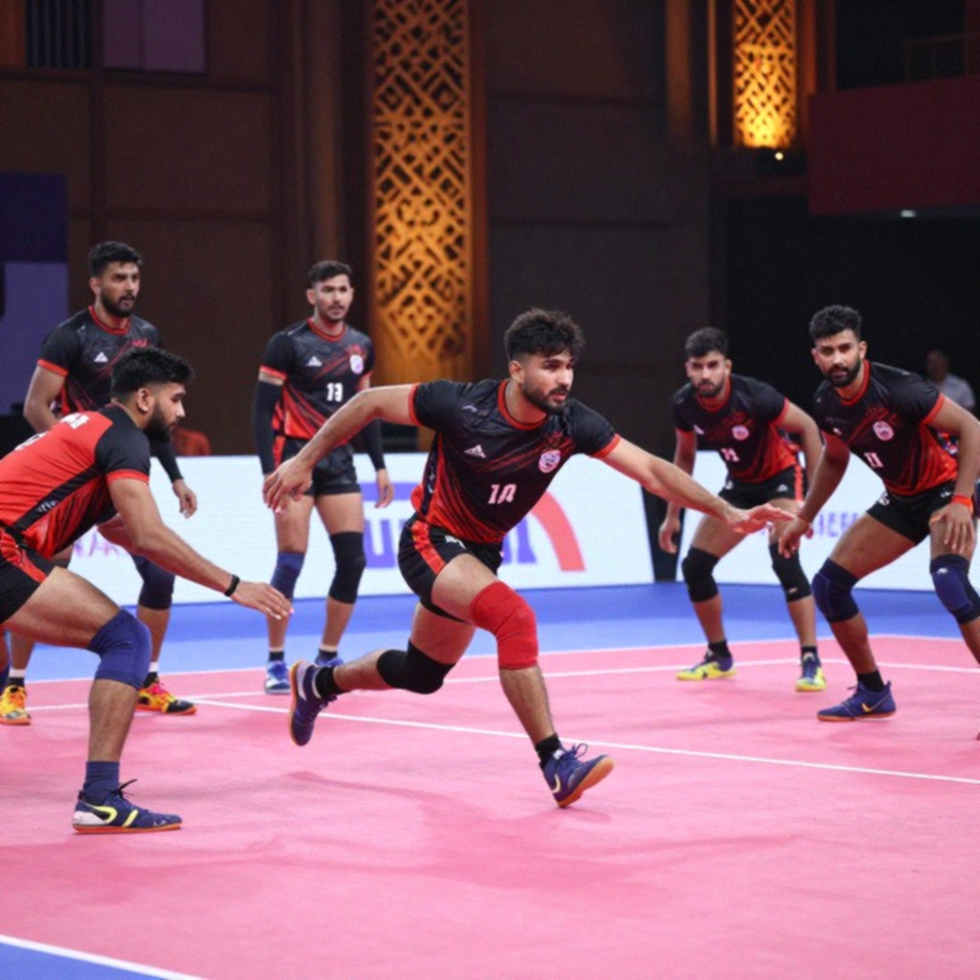
The basic architecture of kabaddi is extremely simple, and that is its greatest strength. A raider crosses into the opponent's half holding his breath, must touch a defender and return, and if his breath breaks on the way back he is out. The defenders' job is to catch him, stop him and bring him safely to the ground. Thirty seconds per raid, seven players a side, boundary lines stretched across a mat — and within those limited resources, endless tactical possibility.
Rule changes in recent years have expanded that possibility. The bonus line made risk-taking easier for raiders. The do-or-die raid removed the third, indecisive raid — now something must happen on every third attempt. The super tackle turned defence from a means of containment into a scoring weapon. And the two extra points awarded after an all-out gave the game a rhythm in which five or six points can swing in a single minute.
The collective effect is that kabaddi is no longer a game of waiting for a mistake. It is a game in which passivity is itself punished.
The new geography of strategy
Until about a decade ago, kabaddi strategy rested mostly on experience and instinct. A coach would watch a player and say, go from the right; the player went on his own reading. Today teams hold data on an opposing raider's preferred direction, his average successful raid distance, the rate at which he is caught, and his behaviour in do-or-die situations.
The shift is clearest in defence. In the old cover defence, players held their positions and waited for the raider to err. In the new system, defenders actively set traps — one player is deliberately left open so that the raider is drawn towards him, and two defenders close the circle from behind. Some teams call it the trap, others the funnel. Different names, one principle: let the raider go where he wants, then make that direction expensive.
Raiding has changed in the same way. Where a raider was once identified by strength and speed, he is now identified by decision-making. When to stop, when to turn, when to choose a toe touch over a hand touch, when to take a risk on the third raid and when to return empty — all of it is now part of the calculation. A good raider is no longer only an athlete; he is a chess player.
Video and data
A team's weekly calendar now splits into three parts: practice on the mat, strength work in the gym, and analysis in front of a screen. The third is the newest and fastest-growing.
Match recordings are no longer kept merely to watch. Every raid is cut into a separate clip. Categories are created — hand touch, body touch, front kick, back kick, dive, chain raid. Then the staff examine which type of raid succeeded against which type of defence. The process is mirrored for defenders: which tackle works in which situation, from which angle a grip is completed, and at which angle a player himself goes down.
One interesting consequence: the game has become more readable, and that has shortened the lifespan of strategies. A trap that was new last season is recognised this season. Teams must reinvent themselves every few months. That is why kabaddi now has system coaches the way football and basketball do.
The price the body pays
Every rapid change has a price, and in kabaddi the body pays it. This is a sport in which a player must stop, turn, fall and rise several times within thirty seconds. Knees, ankles and shoulders carry the most risk. These injuries were once dismissed as part of the game. Today taping, mobility work, strength training and load management are treated as essential parts of preparation.
The real challenge, though, is the calendar. A long league season, then a national camp, then an international competition, then a domestic tournament — in that cycle there is not enough time left for recovery. Many teams now rest players under minute management, much as cricket does. The belief that a player must appear in every match to prove loyalty is slowly changing.
From the akhara to the academy
Kabaddi's greatest strength is its democratic form. It does not require expensive shoes, a large ground or a synthetic track. An empty patch of land, ten or twelve people and a boundary line are enough. That is why the sport draws talent from areas where reaching cricket or football is difficult.
But that same simplicity creates a problem. Villages have talent, but not continuity of guidance. Whether a gifted player receives the right coach, the right nutrition and the right competition at the right age is still a matter of luck. In recent years the number of district academies and school leagues has grown, and that is the healthiest signal available. Because if the player who reaches the top of the league does not create a clear pipeline for those coming below, the talent pool will dry up within a few years.
Another change is worth noting: kabaddi once treated age and experience as supreme. Teams now deliberately give young players opportunities, sign them on cheaper contracts and develop them over two or three seasons. It is an investment-based model, and it has opened doors for young athletes — while also creating the risk that experienced players are pushed out early.
The rise of women's kabaddi
Perhaps the most important development of recent years has not happened in men's kabaddi but in the women's game. Women's competitions existed at national level before, but they received neither broadcast time nor sponsors nor audiences. That has changed — slowly, but visibly.
The women's game is stylistically different from the men's, and that is its strength. It features fewer long, patient raids and more quick, technical touches. In defence, coordination and angle play dominate. A viewer familiar with the power of the men's game sees a different, more controlled side of the sport in the women's game.
The imbalance persists, however. The financial packages available to women players remain considerably smaller than those for men, media coverage is limited, and career security is more uncertain. Until the gap in broadcast and sponsorship narrows, talent will emerge but will not stay.
Market and broadcast
Kabaddi's commercial model is interesting because it is built on local audience taste rather than an imitation of Western sports. A small court, high speed, a decision every thirty seconds, and regional identity attached to teams — the combination is ideal for television and now for mobile screens. A match is easy to start watching, because no complicated rule is needed to follow it.
But the model has a weakness. A large share of kabaddi's revenue depends on a few cities, a few teams and a limited set of sponsors. If broadcast rights values fall, or a major sponsor exits, the effect lands directly on player contracts. That is why sustainable growth requires the sport's roots to deepen in smaller towns and schools, rather than resting on media rights alone.
The international horizon
Kabaddi is part of the Asian Games and is played nationally in a number of countries. Nations such as Iran, Bangladesh, South Korea, Japan and Kenya have established a presence in international competition. The significance of this expansion lies in the fact that the sport is moving beyond the boundaries of South Asia.
Yet there is a basic obstacle on the road to making the game global: kabaddi's popularity remains centred largely on India and its neighbourhood. Earning a place in the Olympic programme requires more than enthusiasm; it requires organised structures across several continents, permanent leagues and population-level participation. That is a long project, and it needs patience more than politics.
The challenges
Every fast-growing sport brings imbalances. Three are visible in kabaddi.
First, administrative stability. In several countries, federation disputes and election controversies affect the competition calendar. Second, player welfare. Contract terms, financial protection after injury and a career after retirement all remain works in progress. Third, the rural-urban gap. When leagues concentrate in cities, resources reach children playing in villages and small towns later than they should.
The answers are organisational rather than technical. A clear calendar, transparent contracts and continuous competition at school level — if these three are implemented properly, the next decade of the sport will be stronger than the last.
In the end
Return to that village akhara. There is now a coach there, a man who once played at district level. In his hand is a phone holding a clip from last week's match. The children sit around him and watch how a boy like them crossed two defenders in a single raid on the third attempt.
The future of the game may be hidden in this scene. Not only in the floodlights of large stadiums, but in the moment when a child first looks at a screen and understands that the sport is not only strength, but thought. That will be kabaddi's real victory — to remain traditional and to become modern at the same time.


संबंधित खिलाड़ी
अनुशंसित
Thirty Seconds of Arithmetic: Telugu Titans Didn't Lose Their Nerve, They Lost Their Tempo2026-10-28
Ahmedabad's First Commonwealth Kabaddi Championship: 13 Nations, 62 Matches, and India's Opening Test Against Malaysia and England2026-10-28
59-30, 23 Raid Points and Three Blank Lines: What Day 1 in Ahmedabad Actually Says2026-10-25
India vs Uganda, Match 9: The 46-26 Scoreline Hides More Than It Reveals2026-10-29
Kabaddi's Real Balance Sheet Is a District Under-16 Entry List, Not a Crore-Rupee Bid2026-10-25
The Day-1 Table Is Not the Final Truth: The Numbers That Will Mislead You at the Commonwealth Kabaddi Championship 20262026-10-25
India vs Uganda: The Real Question Behind 46-26 and 45-29 — and a Fact-Check on the 'Commonwealth' Name2026-10-25
अनुशंसित
Kabaddi: From Mud Courts to Pro League, India's Own Sporting Revolution2026-11-01
Kabaddi's Real Balance Sheet Is a District Under-16 Entry List, Not a Crore-Rupee Bid2026-10-25
Commonwealth Kabaddi: The 62-Match Arithmetic Says the '13 Nations' Line Is Only Half True2026-10-29
Ahmedabad's First Commonwealth Kabaddi Championship: 13 Nations, 62 Matches, and India's Opening Test Against Malaysia and England2026-10-28
Commonwealth Kabaddi Championship 2026: India Poised for Big Win Over Nigeria, But Real Test Hidden by Iran's Absence2026-10-28
India vs Uganda: The Real Question Behind 46-26 and 45-29 — and a Fact-Check on the 'Commonwealth' Name2026-10-25
Thirty Seconds of Arithmetic: Telugu Titans Didn't Lose Their Nerve, They Lost Their Tempo2026-10-28
अनुशंसित
Thirty Seconds, Three Points and July 2026: Auditing Kabaddi's Rule Engine2026-10-25
The Raid-Clock Ledger: Auctions Are Pricing the Name, Not the Do-or-Die Number2026-10-26
Bottom of the Table, Top of the Noise: The Real Ledger of Kabaddi's Retention Window2026-10-31
Ahmedabad's First Commonwealth Kabaddi Championship: 13 Nations, 62 Matches, and India's Opening Test Against Malaysia and England2026-10-28
The Third Raid and the Quiet Corner: What Actually Decides Kabaddi's Regular Season2026-10-25
Before India vs Nigeria: The 42-Point Number That Says More Than Three Wins2026-10-30
The Planted-Foot Arithmetic: 41 Tackles, 33 Ankles, and the Timestamp of a Kabaddi Injury2026-10-26