
होमKabaddiCommonwealth Kabaddi Championship 2026: India's Dominance Continues, Big Win Expected Against Nigeria
Commonwealth Kabaddi Championship 2026: India's Dominance Continues, Big Win Expected Against Nigeria
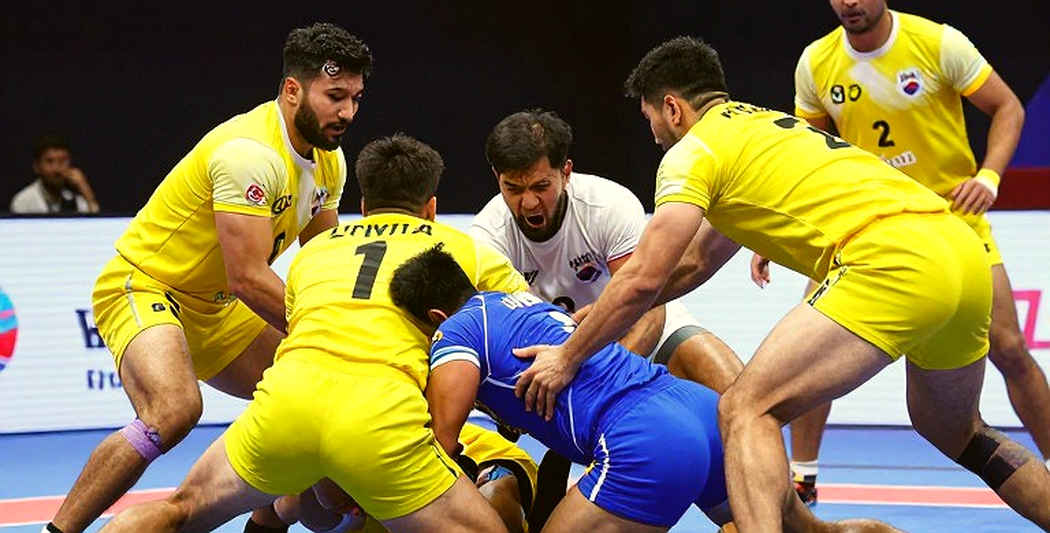
कॉमनवेल्थ कबड्डी चैंपियनशिप 2026 में भारतीय पुरुष कबड्डी टीम ने अपने शुरुआती तीनों मुकाबले जीतकर शीर्ष स्थान हासिल किया है। कप्तान सुरजीत सिंह के नेतृत्व में टीम ने इंग्लैंड को 46-26, युगांडा को 44-30 और मलेशिया को 37-23 से हराया। चौथे दिन भारत का सामना नाइजीरिया से होगा, जो दूसरी और तीसरी श्रेणी की टीमों से भी करारी हार चुका है। हालांकि, ईरान की अनुपस्थिति में भारत का दबदबा एकपक्षीय है। भारत ने प्रति मैच 23-30 अंक खोए हैं, जो डिफेंस में सुधार की जरूरत बताता है। यह चैंपियनशिप कबड्डी के व्यापक लेकिन उथले अंतरराष्ट्रीयकरण को दर्शाती है।
The Indian men's kabaddi team remains at the top of the Commonwealth Kabaddi Championship 2026 after winning all three of its opening matches. Led by captain Surjeet Singh, the team defeated England 46-26, Uganda 44-30, and Malaysia 37-23. On the fourth day, India will face Nigeria, which is considered extremely weak both technically and tactically.
For readers unfamiliar with kabaddi, it is a contact team sport in which a raider crosses into the opponent's half and must touch a defender and return safely within 30 seconds. Throughout the raid, the raider must continuously chant 'kabaddi-kabaddi' to prove he is not inhaling. The defending team scores by stopping the raider in their half. When an entire side is ruled out, the opponent earns two bonus points and all players revive. This 'All Out' rule is the main engine behind kabaddi's fast scoring and frequent comebacks.
Looking at India's three wins, the team scored a total of 127 points and conceded 79, averaging 42.3 scored and 26.3 conceded per match. The scorelines show India won each match by a margin of 14 to 20 points, which is comfortable but not a blowout. Fans have also expressed some disappointment, as they expected bigger margins.
But one statistic reveals India's true defensive strength. England scored 68 against Nigeria but could manage only 26 against India—a 42-point suppression. This shows the Indian defense can suppress high-quality raiders. On the other hand, India conceded 23 to 30 points per game, which can be seen as a warning sign. If India is to truly establish global dominance, it must concede fewer points against weaker teams.
The field is divided into three tiers: India in tier one; England, Tanzania, Malaysia, and Uganda in tier two; and Nigeria in tier three. Nigeria suffered heavy defeats—66-17 to Tanzania and 68-18 to England. This makes clear that Nigeria is far behind even tier-two teams, so its chances against India are extremely slim.
However, there is a major gap in this championship. Iran, India's biggest rival, is not playing in this tournament. Iran is not a Commonwealth member, so it is structurally excluded. Without Iran, India's three wins have come against tier-two and tier-three teams, which somewhat inflates India's apparent dominance. Globally, India and Iran are the two major powers in kabaddi, and without Iran, this tournament has become completely one-sided.
Another challenge for kabaddi globally: although African nations like Nigeria, Tanzania, and Uganda are participating, their involvement is developmental, not competitive. Importantly, kabaddi is not part of the Commonwealth Games; this is a separate 'Commonwealth Kabaddi Championship.' It looks prestigious by name but is well below the Asian Games and the Kabaddi World Cup in standard.
Regarding the organizers, it is unclear which body is running this championship and whether it has International Kabaddi Federation recognition. Such opaque governance creates institutional risk in international sports administration. Many experts believe events like this do not make a solid contribution toward getting kabaddi into the Olympics, because Olympic criteria require a sufficient number of participating countries, continental coverage, and depth in the women's game—none of which are present here.
On the media and commercial side, coverage of this championship is limited mainly to live streaming and telecast. This is not a professional league like the Pro Kabaddi League (PKL), where major broadcast rights, sponsorships, and player auctions generate substantial revenue. Player compensation for national-team duty in such events is modest. Its commercial value is limited.
The India-Nigeria match is likely to be one-sided. Against a Nigeria side that has lost by margins of 44 and 50 points, India's strong side will be on display. For analysts, it will be interesting to see how big a margin India can build, as this will reveal the level of its attacking capability.
India's concern may be that it is conceding 23 to 30 points per match. Against weak opponents, this suggests India's defense is 'good enough to win' but not 'airtight.' Another important point is that the source provides only team totals, no individual player statistics. So it is difficult to assess whether India's offense depends on a single raider. This is a data gap that cannot be ignored. Captain Surjeet Singh is the only named player, and his role (raider or defender) is unclear.
A positive aspect of this championship is that it reflects kabaddi's internationalization as broad but shallow. Many flags appear on the field, but very few competitive nations. Nigeria's heavy defeats are a symptom, not a coincidence. India's continued success is the result of a deep-rooted sports culture, with a strong ecosystem from rural akhadas to government jobs (railway, police, army). The Pro Kabaddi League has given the sport television exposure and professional status, giving India a structural advantage.
In conclusion, the Commonwealth Kabaddi Championship 2026 means little more than a name for India. With Iran absent, India's dominance is clear, but it does not give the full picture of its true global strength. The match against Nigeria is almost a formality, and the real question is whether India can overcome its defensive softness and show a more aggressive attack. Only then can India benefit against strong teams like Iran in upcoming major tournaments.
संबंधित खिलाड़ी
अनुशंसित
Indian Hockey’s New Playbook: Youth Energy, Data and Olympic-Cycle Preparation2026-10-28
Commonwealth Kabaddi: The 62-Match Arithmetic Says the '13 Nations' Line Is Only Half True2026-10-29
The Day-1 Table Is Not the Final Truth: The Numbers That Will Mislead You at the Commonwealth Kabaddi Championship 20262026-10-25
Thirty Seconds of Arithmetic: Telugu Titans Didn't Lose Their Nerve, They Lost Their Tempo2026-10-28
India vs Uganda, Match 9: The 46-26 Scoreline Hides More Than It Reveals2026-10-29
Before India vs Uganda, Read the 46-26 Again: It Is Not a Certificate of Dominance, It Is a Red Flag on Defence2026-10-27
The Empty Medical Column: Reading Kabaddi's Transfer Window Through Evidence, Not Noise2026-10-25
अनुशंसित
The Third Raid and the Quiet Corner: What Actually Decides Kabaddi's Regular Season2026-10-25
Nigeria Is Fourth, and It Hasn't Raided Once2026-10-25
Kabaddi's Biggest Finding Is the Column the Scoresheet Left Blank2026-10-24
Before India vs Nigeria: The 42-Point Number That Says More Than Three Wins2026-10-30
Commonwealth Kabaddi: The 62-Match Arithmetic Says the '13 Nations' Line Is Only Half True2026-10-29
Ahmedabad's First Commonwealth Kabaddi Championship: 13 Nations, 62 Matches, and India's Opening Test Against Malaysia and England2026-10-28
Commonwealth Kabaddi Championship 2026: India's Dominance Continues, Big Win Expected Against Nigeria2026-10-27
अनुशंसित
India vs Uganda: The Real Question Behind 46-26 and 45-29 — and a Fact-Check on the 'Commonwealth' Name2026-10-25
Ahmedabad's First Commonwealth Kabaddi Championship: 13 Nations, 62 Matches, and India's Opening Test Against Malaysia and England2026-10-28
Indian Hockey’s New Playbook: Youth Energy, Data and Olympic-Cycle Preparation2026-10-28
Nigeria Are Fourth in Ahmedabad Without Playing a Single Raid2026-10-29
The Day-1 Table Is Not the Final Truth: The Numbers That Will Mislead You at the Commonwealth Kabaddi Championship 20262026-10-25
Commonwealth Kabaddi: The 62-Match Arithmetic Says the '13 Nations' Line Is Only Half True2026-10-29
The Empty Medical Column: Reading Kabaddi's Transfer Window Through Evidence, Not Noise2026-10-25