
Commonwealth Kabaddi Championship 2026: Pakistan's Withdrawal, Asian Games Disappointment, and the Standard Style Challenge
कॉमनवेल्थ कबड्डी चैंपियनशिप 2026 (23-31 अक्टूबर, अहमदाबाद) से पाकिस्तान ने अपना नाम वापस ले लिया है, जिससे मैदान 14 से 13 देशों का रह गया। इसका मुख्य कारण एशियाई खेल 2026 में पाकिस्तान का पदक-रहित प्रदर्शन माना जा रहा है, जहां वह सेमीफाइनल तक नहीं पहुंच सका। विश्लेषकों के अनुसार पाकिस्तान का कबड्डी ढांचा सर्कल स्टाइल पर आधारित है, जबकि यह चैंपियनशिप स्टैंडर्ड स्टाइल में है — जिससे पाकिस्तान संरचनात्मक रूप से पिछड़ जाता है। ईरान (कॉमनवेल्थ सदस्य नहीं) और चीनी ताइपे भी अनुपस्थित हैं, जिससे मैदान कमजोर हुआ है और भारत का दोहरा स्वर्ण लगभग तय है। हालांकि, पाकिस्तान की वापसी के कारणों की स्वतंत्र पुष्टि नहीं हुई है, और यह राजनीतिक या प्रशासनिक भी हो सकता है।
Ahmedabad: The world of kabaddi is set to open a new chapter from 23 to 31 October 2026 — the inaugural edition of the Commonwealth Kabaddi Championship. Staged at the Veer Savarkar Sports Complex in Ahmedabad, Gujarat, the tournament is being billed as the second major kabaddi event of the calendar year. But even before this historic event begins, a major blow has landed — Pakistan has withdrawn its name from the championship. The field was originally announced as 14 nations; it now stands at 13. Pakistan's withdrawal is not merely an administrative decision; it points to the crisis through which Pakistani kabaddi is currently passing — and the story is directly linked to the disappointment of the Asian Games 2026.
The Asian Games disappointment: a medal drought
To understand this withdrawal, one must look at the kabaddi results from the 2026 Asian Games. According to reports, the Pakistan men's kabaddi team failed to reach the semi-finals and won no medal. It is claimed that this was the first time Pakistan failed to win at least a bronze in kabaddi. The fact is significant because Pakistan has traditionally been counted among the stronger kabaddi nations. It had a long record of winning medals at the Asian Games, and the sudden breaking of that record signals a major crisis.
One clarification is necessary here. The claim that this is Pakistan's first-ever medal-less Asian Games performance should not be treated as final fact without independent verification against Olympic Council of Asia records. Pakistan has previously stood on the Asian Games kabaddi podium at bronze and silver level. The claim should therefore be treated cautiously. Even so, the core point stands: Pakistani kabaddi's performance is trending downward, and this decline is not the result of one bad tournament but a signal of a structural problem.
Standard Style vs Circle Style: the real challenge
Understanding the reasons behind Pakistan's withdrawal requires understanding the difference between kabaddi's two formats. Standard Style is the format used at the Asian Games and in the Pro Kabaddi League (PKL) — rectangular court, seven players per side, international rules. Circle Style, by contrast, is played on a circular field, commonly with eight players per side and simplified scoring. It dominates rural Punjab on both sides of the India–Pakistan border.
The difference is not merely technical; it directly affects the strength of both teams. In Circle Style a raider can retreat without penalty; in Standard Style he cannot. Teams raised on Circle Style produce raiders who are excellent in one-on-one evasion but weak in structured, multi-defender Standard Style raids. Pakistan's problem is likely exactly this — its kabaddi structure is built on Circle Style, and when it must play Standard Style, it falls behind structurally.
Bonus Line and Do-or-Die: the pressure of new rules
Some Standard Style rules are especially challenging for Pakistan. The Bonus Line rule — crossing the line deep in the opponent's half while the defence has six or more players on court earns one point — is a powerful tactical weapon. Teams without a bonus-line raider are forced into low-percentage touch raids. This is precisely the problem seen in Pakistan's recent Standard Style outings.
The Do-or-Die raid rule also matters — after two consecutive empty raids, the third raid must score, or the raider himself is out. This rule forces conservative teams to attack. Circle Style usually does not have this rule, so teams raised on it are unprepared for the pressure. In addition, the 30-second raid limit and the continuous "kabaddi-kabaddi" cant form a built-in "breath clock" — demanding a discipline entirely different from the free-flowing nature of Circle Style.
India's double gold: structural dominance
At the 2026 Asian Games, India won gold in both the men's and women's events. This reflects India's kabaddi dominance, but it is no surprise. India has a deep bench of PKL-trained, data-coached players — more than 20 international-standard athletes. India's structural advantage lies not in one star raider but in replaceability at every position. This is the exact opposite of Pakistan's situation, where there is no PKL exposure, no overseas-club pathway, and a domestic circuit dominated by Circle Style.
Iran's absence: a hollowed field
Iran and Chinese Taipei are also not participating in the Commonwealth Championship. Iran is the world's second-strongest kabaddi nation and the only country capable of challenging India. But Iran is not a Commonwealth member, so its absence is natural. This is the structural ceiling of the event — the Commonwealth framework excludes the one team capable of beating India. This is a design flaw, not a scheduling accident.
Chinese Taipei's absence matters more in the women's draw, as its women's programme has been an Asian Games medallist. The absence of both Iran and Chinese Taipei suggests that Asian federations regard this event as a low-priority, non-ranking fixture.
Pakistan's withdrawal: political or competitive?
When considering the reasons behind Pakistan's withdrawal, two possibilities arise. First, it could be a political decision. Second, it could be a competitive decision — a team that has just lost its long medal record at the Asian Games faces a field it cannot beat, in a format it does not master.
Logically, Pakistan's withdrawal should be seen not only as political but possibly as rational. This is a team strong in Circle Style but weak in Standard Style. Playing in Ahmedabad — the heartland of India's Standard Style — would be even more challenging. Last-minute national-team withdrawals in the kabaddi world are often administrative (clearance, visas, funding), but in this case competitive reasons are also present.
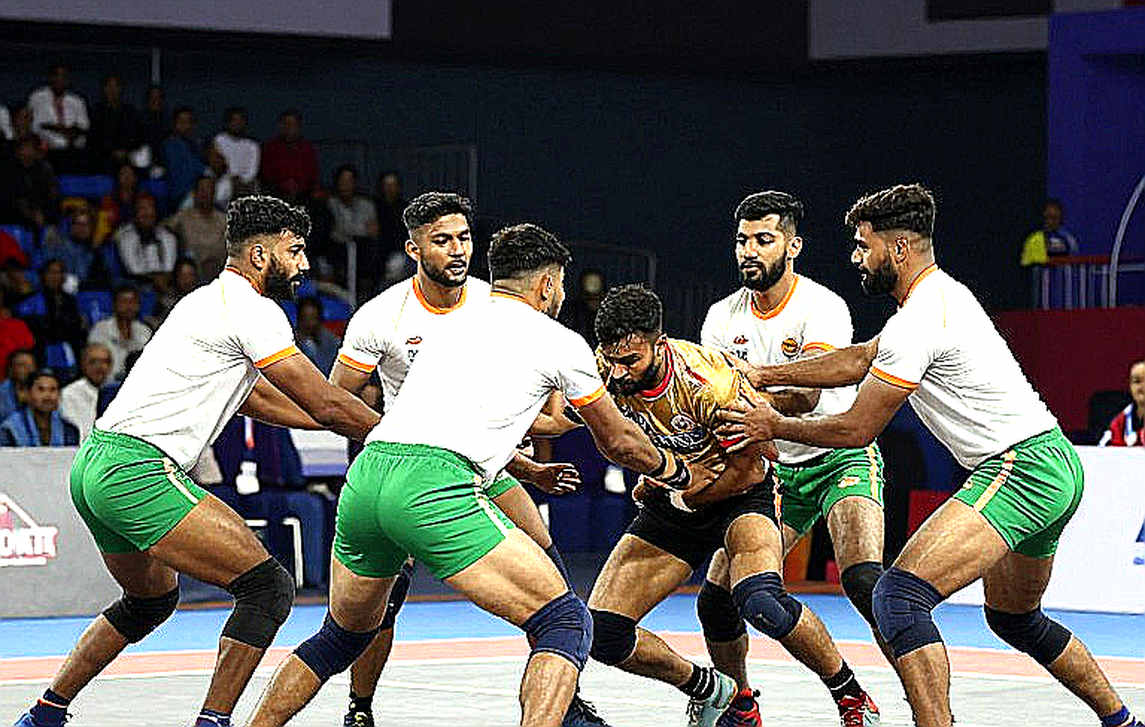
One point deserves attention. Pakistan has previously travelled to Ahmedabad for kabaddi competition — the 2026 Kabaddi World Cup was staged there with Pakistani participation. Venue-specific hostility is therefore a weak explanation, and something else has changed.
The structural problem of international kabaddi
This withdrawal also has a broader context. The scarcity of international competitions is a longstanding problem in international kabaddi. The report itself concedes that international kabaddi competitions are limited. This means every forfeited appearance costs a national programme a disproportionate share of its annual development value. Pakistan's withdrawal makes this problem worse.
Another important point — the 2026 international calendar essentially contains only two events: the Asian Games and the Commonwealth Championship. There is no ranking or qualifying pathway linking them. This is a structural weakness of international kabaddi. In addition, the October 2026 schedule collides with the PKL's traditional October–December broadcast window, creating a direct player-availability conflict for India.
The biggest commercial loss
From a commercial perspective, Pakistan's absence is the most damaging of the three. Iran's absence weakens the sporting standard, but Pakistan's absence removes the one fixture with genuine emotional and broadcast pull — an India–Pakistan match. The India–Pakistan fixture holds a special place in kabaddi, and its absence dims the tournament's lustre.
Questions over the event's prestige
Another important point is that calling this event a "major international tournament" would be premature. It is an inaugural edition, its sanctioning authority is unclear — is it the IKF, a Commonwealth kabaddi body, or a national federation operating unilaterally? That single fact determines the value of the title. South Asian media routinely over-label such events. Until the sanctioning authority is confirmed, the event's prestige should be viewed cautiously.
A 13-nation field may look numerically large, but competitively it is small. Without Iran, Chinese Taipei and Pakistan, the effective competitive field is India plus a group of nations for whom a semi-final is the realistic ceiling.
Conclusion
Pakistan's withdrawal is a multi-dimensional event. It is not merely an administrative decision but a reflection of Pakistani kabaddi's structural problems, the gap between Standard and Circle Style, and the broader weaknesses of international kabaddi. When the championship begins in Ahmedabad on 23 October 2026, India's double gold will be all but assured. But the real question is whether this tournament can give international kabaddi the platform it needs — or whether it will become yet another event in which India wins and everyone else merely participates. Pakistan's withdrawal sharpens that question further.